Surfboards for Tropical Waves: Ultimate Guide
Discover the ideal surfboards for tropical waves, whether you're tackling punchy reef breaks, mellow beach breaks, or embarking on your first tropical surf trip. This ultimate guide helps you select the perfect board for any warm-water adventure, ensuring maximum performance and fun. Get ready to carve up paradise!
Surfboard Life · March 5, 2026 · 13 min read
Surfboards for Tropical Waves: The Ultimate Guide to Your Paradise Quiver
For surfers dreaming of crystal-clear waters and consistent, warm swells, selecting the right surfboards for tropical waves is paramount to an unforgettable trip. The ideal board for tropical conditions often balances maneuverability, speed, and durability, catering to the unique characteristics of warm-water breaks. This comprehensive guide from Surfboard Life will help you build the perfect tropical surf trip quiver, whether you're a seasoned expert or searching for your first beginner tropical surfboard.
Tropical surfing is synonymous with hollow barrels, peeling point breaks, and warm, forgiving conditions. However, not all tropical waves are created equal. From the powerful, often shallow tropical reef surfboards demand to the softer, more forgiving tropical beachbreak surfboards allow, understanding the nuances of these environments is key to choosing your next stick. This article dives deep into board selection, fin setups, and practical tips to maximize your performance in paradise.
Understanding Tropical Wave Dynamics: Reef vs. Beach Breaks
Tropical waves encompass a vast spectrum, but broadly, they can be categorized into reef breaks and beach breaks. Each demands a different approach to board design and characteristics.
Tropical Reef Surfboards: Performance & Durability
Reef breaks, common throughout the South Pacific, Indo, and Central America, often produce powerful, hollow, and predictable waves. These breaks are fueled by deep ocean swells that hit shallow coral or rock formations, creating steep take-offs and fast, barreling sections. For these conditions, you need a board that can handle speed, maintain control in critical sections, and offer quick turns.
- Characteristics: Often punchy, hollow, consistent, and can be fast. The water is generally deep enough for take-offs but quickly becomes shallow over the reef. Waves tend to break in the same place, making them predictable yet demanding.
- Board Requirements: Boards for reef breaks need excellent drive, hold, and precise maneuverability. Durability is a significant factor, as contact with a reef can be catastrophic for your board (and body!). Advanced constructions might also come into play for maximum performance, with innovations like basalt fiber weaves and refined epoxy resins enhancing resilience.
Experienced shapers recommend boards with a bit more rocker in the nose for late drops, a narrower outline for speed and control, and often a slightly thicker foil under the chest for paddle power into fast-moving swells. "You need a board that feels secure on rail when you're flying down the line, but can also turn on a dime in the pocket," notes one pro surfer interviewed by Stab Magazine.
Tropical Beachbreak Surfboards: Versatility & Forgiveness
Beach breaks, found globally, are characterized by sand bottoms and often shifting peaks. While they can be powerful, especially during good swells, they tend to be more forgiving than reefs. They offer a wider range of conditions, from mellow, rolling waves perfect for longboarding to punchy, A-frame barrels.
- Characteristics: Less predictable due to shifting sandbars, can offer both mushy and powerful sections, generally safer for falls due to the sand bottom. Offers a diverse range of peak types and wave forms.
- Board Requirements: Versatility is key. You'll want a board that can excel in weaker waves but still handle a bit of punch. Boards with wider points for stability and paddle power, and a more forgiving outline, are often preferred. Look for a balance of drive and agility.
For beach breaks, especially if you're exploring new spots, a board that paddles easily and generates speed in varying conditions will be your best friend. A good entry-level or intermediate surfer might find more success on boards with slightly fuller outlines, particularly through the nose and tail, and more volume, optimizing for wave count. Recent advancements in foam core materials are also offering improved floatation without excessive bulk.
The Ultimate Tropical Surf Trip Quiver: Tailoring to Your Skill Level
Building a tropical surf trip quiver isn't a one-size-fits-all endeavor. It depends heavily on your surfing ability, the specific conditions you anticipate, and your personal surfing style.
Beginner Tropical Surfboards: Stability, Volume & Fun
Starting your surfing journey in warm, tropical waters is a dream for many. For beginners, the focus should always be on stability, paddle power, and durability. A beginner tropical surfboard needs to be forgiving to help you catch waves easily and progress quickly.
- Soft-top Longboards/Funboards: These are ideal. Soft-tops negate the fear of impact with the board and are extremely buoyant, making wave catching a breeze. A 7'0" to 9'0" soft-top is perfect for learning the basics. Many modern soft-tops now feature internal stringers for improved rigidity and performance, mimicking the feel of a hardboard more closely. For more on beginner boards, check out our Learn to Surf guide.
- Epoxy Funboards: Durable and stable, epoxy funboards (7'0" - 8'0") offer a good bridge between soft-tops and traditional hardboards. They have plenty of volume for easy paddling and stability, making them excellent for consistent progression. Use our Volume Calculator to find your sweet spot, aiming for higher volume for beginners.
Pro Tip: Don't be afraid to go big! Many beginners overestimate their ability and choose a board that's too small. More volume equals more waves, which equals faster progression. Focus on catching waves and riding straight before worrying about turns. Consider sustainability in your purchase with brands offering recycled materials or circular economy initiatives, which are becoming more prevalent in the industry.
Intermediate Quiver: Versatility & Performance Progression
Intermediate surfers are past the foundational stage and are looking to connect turns, generate speed, and confidently ride down the line. A tropical surf trip quiver for intermediates needs boards that offer a blend of stability and responsiveness, allowing for skill development across varied conditions.
- Hybrid Boards: These are fantastic for the variability of tropical waves. A 5'8" to 6'4" hybrid board with a wider nose and tail, often with a swallow or squash tail, will provide excellent paddle power and maintain speed through flatter sections on tropical beachbreak surfboards. These bridge the gap between fish and shortboards, offering maneuverability without sacrificing wave count.
- Performance Fish/Fun Shortboards: A modern fish (5'4" - 5'10") excels in smaller to medium, less powerful waves, often found at less critical tropical beachbreak surfboards or mellower reef passes. Their width and flatter rocker make them incredibly fast and fun. For slightly more power, a performance shortboard hybrid (e.g., a modern 'groveler' style) around 5'10" - 6'2" is a great all-rounder that blends speed with tighter turning radii.
Pro Tip: Consider a 5-fin setup (Future or FCSII, explored in our Fin Systems Guide). This allows you to experiment with different fin configurations (thruster, quad) to adapt to varying wave conditions, from punchy beach breaks to more drawn-out reef sections. Recent fin designs also offer enhanced flex patterns for specific responses, with advanced materials like carbon composites and honeycomb cores becoming standard.
Expert/Advanced Quiver: Precision, Speed & Barrels
For advanced surfers chasing critical waves and barrels, the surfboards for tropical waves need to be highly refined performance tools. This usually means a multi-board quiver tailored to specific wave types and conditions.
- Performance Shortboard (Daily Driver): Your go-to for 3-6 foot waves. Typically 2-4 inches taller than your height, with a narrower outline, moderate rocker, and a thruster or quad setup. This is your workhorse for aggressive turns and maintaining speed on fast, hollow waves. Aim for a volume close to your personal sweet spot, which you can fine-tune with our Volume Calculator and adapt based on recent innovations in foam density and stringerless designs that utilize internal carbon rods for controlled flex.
- Step-Up Board: Absolutely essential for bigger, hollower waves, especially when seeking barrels on specific tropical reef surfboards. This board will be 4-8 inches longer than your daily driver, with more nose rocker, a narrower tail, and often slightly more volume for paddle power into larger swells. A classic example would be a rounded pin tail for hold in critical situations. Think Pyzel Ghost Pro or similar designs favored by pros on the WSL tour. Advanced shapers are also experimenting with carbon-fiber inserts to fine-tune flex and pop, and even some smart-fin integration for real-time performance data.
- Small Wave Groveler/Specialized Fish: Even in the tropics, small days happen. A specialized small wave board (2-6 inches shorter than your daily driver, wider, flatter rocker, often with advanced bottom contours like channels or concaves) will keep you in the water and having fun when the main swell drops. This is perfect for those waist-high, playful tropical beachbreak surfboards or slow rolling reef sections. Some advanced designs feature twin-plus-trailer or elaborate quad setups for maximum speed in weak conditions, often incorporating specialized materials for lighter swing weight.
Pro Tip: Always carry ding repair kits. Tropical sun, travel, and reef encounters can cause unexpected damage. Familiarize yourself with basic repairs or locate a local Repair Center in your destination. Consider travel-friendly resin options that cure quickly in UV light, including new eco-friendly formulas.
Key Features and Considerations for Tropical Surfboards
Beyond specific board types, certain design elements and accessories become crucial when surfing in the tropics.
Rocker Profile: Taking the Drop
Rocker, the curve of the board from nose to tail, is critical. More nose rocker helps prevent pearling on steep take-offs, a common occurrence on slabby tropical reef surfboards. A flatter mid-section helps generate speed on weaker waves, while tail rocker dictates how quickly the board can turn. Balancing these elements is key for a good "all-rounder" board for tropical waves. Modern shapers are increasingly using computer-aided design to create progressive rocker profiles that blend these characteristics seamlessly, sometimes even with subtle variations in rocker line from rail to rail.
Tail Shapes: Hold, Drive & Release
Different tail shapes offer distinct performance characteristics:
- Squash Tail: Versatile, good balance of hold and release. Excellent for tropical beachbreak surfboards and everyday performance. Often the base for variations in width and corner curvature, and modern interpretations might feature subtle wingers or channels.
- Swallow Tail: Adds bite and liveliness, great for generating speed in smaller, weaker waves, often seen on fish or hybrid designs. The depth and width of the swallow can significantly alter its feel, with narrower, deeper swallows offering more control.
- Rounded Pin Tail: Maximum hold and control in powerful, hollow waves. The go-to for step-ups and barrels on demanding tropical reef surfboards. Provides a smooth, continuous rail line for carving, and can vary in roundness for different degrees of release.
- Pin Tail: Even more extreme hold than a rounded pin, typically for very big, powerful waves where ultimate control is paramount. Less common for general tropical trips but crucial for big wave surfing.
Learn more about these components in our Surfboard Anatomy guide.
Fin Setups: The Engine of Your Board
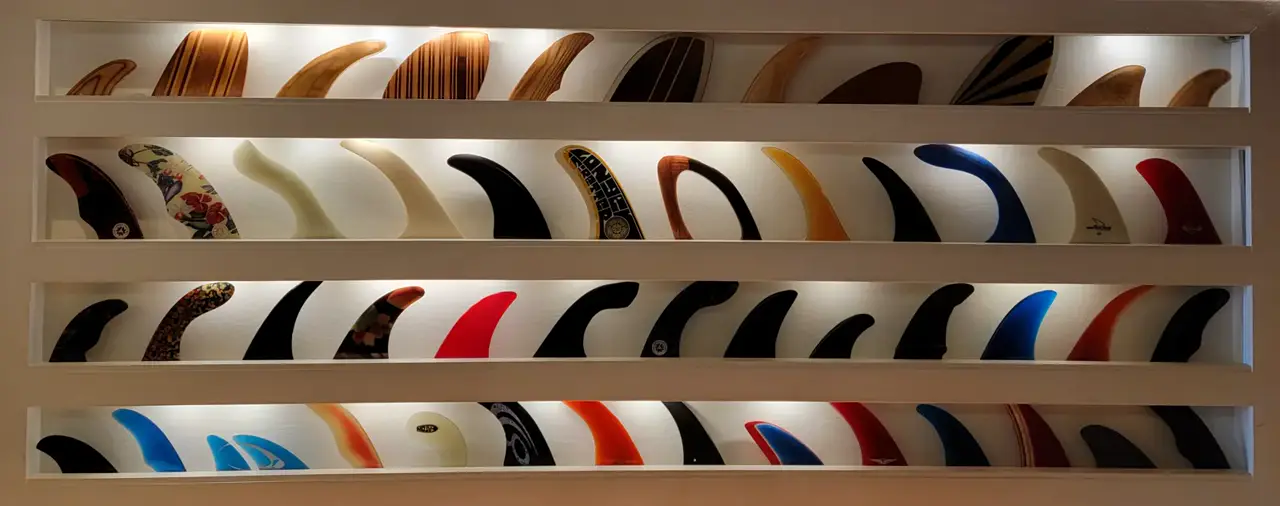
Fins have a profound impact on how your board performs. In tropical conditions, especially on reef breaks, strong, durable fins are important. Recent developments in fin materials and foil designs offer even more specific performance characteristics, including advanced hydrodynamics and flex patterns.
- Thruster (3 fins): The most common and versatile setup. Offers a balance of speed, drive, and control. Ideal for a wide range of surfboards for tropical waves. Many new thruster sets feature innovative flex patterns and refined foils that generate more lift and speed.
- Quad (4 fins): Faster and looser than a thruster, great for generating speed across flatter sections and creating powerful drive on rail. Excellent for tubes and faster, less critical turns often found on wider outlines or as a faster option for point breaks. Recent innovations in quad geometry are optimizing flow and reducing drag.
- Twin Fin (2 fins): Super fast and free, with less hold. Perfect for maximizing fun on smaller, playful waves or stylish flow on retro fish designs. Often paired with a small trailer fin ("twin + trailer") for added stability and drive without losing the loose feel. Modern twin fins are increasingly shaped with advanced foils for more control.
Many expert surfers will bring multiple fin sets to adapt their tropical surf trip quiver to the daily conditions. Our Fin Systems Guide provides an in-depth look at fin choices, including considerations for fin rake, area, and flex.
Construction & Durability
Tropical travel and surfing can be hard on boards. Seek out constructions known for durability if you're frequently traveling. EPS epoxy constructions are lighter and more buoyant, and often more ding-resistant than traditional PU. Many brands are now integrating advanced materials like carbon fiber, basalt, or flax into EPS constructions for enhanced performance and durability (e.g., Varial Foam, Firewire's LFT or Ibolic, Lib Tech's Ecoptimist). However, PU still offers a classic, dampened feel preferred by many pros, especially in powerful conditions. If you're bringing a pricier board, invest in a good board bag, ideally with extra padding, internal straps, and reinforced nose/tail sections, with new designs featuring improved ventilation and lighter, tougher fabrics.
Pro Tip: Wax selection matters. Tropical water wax is essential. Regular cold-water wax will melt off your board, leaving you slipping. Always pack extra tropical wax, and consider an eco-friendly brand. Some advanced surfers are experimenting with traction sprays or alternative deck coatings to reduce wax dependence.
The All-Rounder: Your Single Board Tropical Solution
If you're limited to bringing just one board on your tropical surf trip quiver, versatility is key. An excellent choice would be a performance hybrid or a modern all-rounder high-performance shortboard, designed to cover a broad range of wave types.
- Volume: Aim for slightly above your typical performance shortboard volume to ensure easier paddling and wave catching across varying conditions. Our Volume Calculator can help you dial this in, considering modern distribution techniques like foam volume under the chest that balances float and maneuverability.
- Outline: A slightly wider nose toward the front foot and a more forgiving tail (like a rounded squash or swallow) provides a good balance of speed generation and turning ability. A subtle single-to-double concave bottom contour can also enhance this versatility. Some 2025-2026 designs are featuring slightly fuller rails that are tucked for performance.
- Fin Setup: A 5-fin box setup (enabling thruster or quad) makes this board adaptable to almost any wave you'll encounter, from gentle tropical beachbreak surfboards to more demanding reef sections. This flexibility is paramount for a single-board trip.
Many brands offer models specifically designed as travel-friendly all-rounders, such as the Hypto Krypto or similar performance fish/hybrid shortboards. These are often highlighted in Surfer Magazine's travel features, with new iterations regularly pushing the boundaries of all-condition performance.
Case Study: Perfecting Your Quiver for Specific Tropical Destinations
- Mentawais, Indonesia (Primarily Reef Breaks): An advanced surfer's dream. Your tropical surf trip quiver must include a very capable performance shortboard (5'10"-6'2" with good rocker and a durable construction, perhaps with a subtle channel bottom for extra hold) and a substantial step-up (6'4"-6'8" for serious hold in barrels, often a rounded pin or baby swallow). A specialized tube-riding fin set (smaller, stiffer rear fins) is highly beneficial. Maybe a small-wave groveler for those rare slower days between swells, or a committed step-down fish for playful reef exploration. Consider integrated deck pads for extra grip and protection, and potentially a multi-segment traction pad for ultimate customization.
- Costa Rica (Mix of Beach & Reef): Great for all levels. An intermediate surfer could thrive with a versatile hybrid shortboard (5'8"-6'2" with a 5-fin setup) and perhaps a funboard (6'8"-7'4") for smaller days or learning on the gentler breaks. Advanced surfers might bring their daily driver and a playful fish for the country's diverse beach breaks, potentially a dedicated longboard for the longer, mellower point breaks. For the intermediate, a modern mid-length (7'0"-8'0") with a versatile 2+1 or quad fin setup is also gaining popularity for its blend of paddle power and maneuverability.
- Beginner-Friendly Spots (e.g., Waikiki, Hawaii): Less about shredding, more about learning and long, gentle rides. A 7'0"-9'0" soft-top or epoxy funboard is the ideal beginner tropical surfboard. Forget the shortboard unless you're truly just learning how to stand up; prioritize volume and stability for maximum wave count and enjoyment. Consider newer soft-top designs that offer improved rail shapes for more dynamic turns, even for beginners.
Beyond the Board: Essential Tropical Surf Trip Accessories
You've got your surfboards for tropical waves sorted, but don't forget the supporting cast. These essential extras ensure your trip goes smoothly and safely.
- Tropical Wax: Absolutely non-negotiable. Grab at least 3-4 blocks of a high-quality, eco-friendly tropical wax.
- Leashes: At least two new, strong leashes for each board. Reefs and heavy waves can snap leashes. Go for quality and consider a slightly thicker leash for bigger conditions. Look for innovative swivel designs that prevent tangles.
- Sun Protection: High SPF reef-safe sunscreen, UPF-rated rashguards (long sleeve advised), wide-brimmed hats, polarized sunglasses, and a lip balm with SPF. The tropical sun is incredibly intense and damaging. Many new rashguards offer advanced cooling fabrics.
- Booties/Reef Shoes: Essential for walking over sharp coral on tropical reef surfboards and preventing cuts. Opt for thin, flexible booties for maximum board feel, or thicker soles for more rugged environments. New designs offer improved grip and quick-dry features.
- Repair Kit: Ding tape, quick-cure resin (solar-activated works well), sandpaper, and possibly some fiberglass cloth for