Cold Water Surfboard Guide: Winter Board Framework
Selecting the right cold water surfboard requires adjusting volume, foam density, and outline for heavy neoprene and frigid seas. Master your winter quiver with our expert guide.
Surfboard Life · October 31, 2026 · 12 min read
A cold water surfboard requires 5% to 15% more volume, slightly flatter entry rocker, and a more forgiving outline than a standard summer board. This extra float compensates for heavy neoprene wetsuits, diminished paddler stamina, and denser seawater, ensuring you paddle efficiently and catch fast-moving swells in demanding winter conditions.
Surfing in sub-55°F (13°C) oceans changes the physics of both the ocean and human performance. Between the added weight of thick rubber, bone-chilling winds, and heavy winter groundswells, your standard warm-water shortboard simply will not perform the same way. Whether you are navigating the frosty point breaks of the Pacific Northwest, rugged slabs in Ireland, or freezing winter beach breaks in New England, riding a tailored winter surfboard can make the difference between scoring the waves of your life and shivering on the shoulder.
In this comprehensive buyer's framework, we dive into the hydrodynamic realities of freezing water, compare construction materials like PU and EPS, break down volume formulas by skill level, and reveal the best surfboards for cold water across different oceanic regions.
Why You Need a Dedicated Cold Water Surfboard
Many surfers make the mistake of paddling out in mid-winter on the exact same craft they used during August. However, frigid oceans present distinct environmental and physiological challenges that require an adjusted approach to board design.
1. The Heavy Neoprene Penalty
A full winter kit—consisting of a 5/4mm or 4/3mm hooded wetsuit, 5mm or 7mm booties, and 3mm claw gloves—can easily add 8 to 12 pounds (3.6 to 5.4 kg) of saturated deadweight to your frame. Furthermore, thick neoprene constricts shoulder mobility, cutting paddling cadence by an estimated 15% to 20%. Without extra buoyancy under your chest, you will sit deeper in the water and struggle to match wave speeds.
2. Water Density and Surface Tension
Cold water is physically denser than warm water. As water temperatures drop from 75°F (24°C) down to 40°F (4°C), salinity and thermal contraction cause water molecules to pack tighter. While denser water theoretically generates slightly more hydrodynamic lift once on a plane, the increased drag against your body and board during the entry phase delays takeoff. A specialized cold water surfing board offsets this initial resistance through wider forward outlines and refined foam distribution.
3. Raw Ocean Energy and Heavy Currents
Winter swells generally originate from volatile, high-latitude low-pressure systems. These storms produce thicker, more powerful waves flanked by violent tidal rips and howling offshore or sideshore winds. A lightweight, paper-thin performance board will chatter and skip across choppy faces, while a purpose-built craft provides the drive, momentum, and dampening required to hold an edge.
Pro Tip: Never assume your summer volume works year-round. Check our Volume Calculator to recalculate your target literage based on wetsuit thickness, bootie weight, and water temperature.
Cold Water Surfboard Volume & Sizing Framework
When calculating the dimensions for a surfboard for cold water, volume is your most critical metric, but outline and foil distribution run a close second. Experienced shapers typically recommend increasing your everyday volume by 1.5 to 4 liters, depending on the water temperature bracket and your experience level.
Target Cold Water Volume = Base Summer Volume + Wetsuit Compensation Factor (Liters)
The Neoprene Temperature Multiplier:
- Chilly Water (55°F to 62°F / 13°C to 17°C): Add +1.0 to +1.5 Liters. Typical suit: 3/2mm or 4/3mm without accessories.
- Cold Water (45°F to 54°F / 7°C to 12°C): Add +2.0 to +3.0 Liters. Typical suit: 4/3mm or 5/4mm hooded with booties and gloves.
- Sub-Zero / Frigid Water (<45°F / <7°C): Add +3.5 to +5.0 Liters. Typical suit: 5/4mm or 6/5mm hooded with 7mm booties and mittens.
Outline and Rocker Adjustments
Beyond simple volume, pay close attention to the surfboard anatomy:
- Nose Width & Forward Thickness: Pull foam forward underneath the chest. A wider chest area and slightly relaxed nose rocker allow you to plane immediately, securing critical paddle speed before ledging drops.
- Rocker Profile: Moderate or staged rocker outperforms aggressive continuous curve in cold, disorganized lineups. It maintains down-the-line speed across dead sections where freezing water saps wave momentum.
- Tail Design: Round pins and rounded squares reign supreme. Swallow tails work wonders for weak, gutless winter chop, but when solid cold-water swells pulse, rounded tails provide controlled hold without sliding out on icy drops.
PU vs. Epoxy vs. Soft-Top: Construction in Sub-50°F Waters
How does core material handle near-freezing ocean temperatures? Construction is often overlooked, yet foam density, resin flexibility, and core thermal stability react distinctly in icy environments.
+---------------------+-------------------+-------------------+-------------------+
| Material Metric     | Polyurethane (PU) | EPS / Epoxy       | Molded Soft-Top   |
+---------------------+-------------------+-------------------+-------------------+
| Cold Water Flex     | High (Natural)    | Stiff / Rigid     | Very Damp / Soft  |
| Wind Chatter Choke  | Excellent         | Poor (Bouncy)     | High              |
| Durability vs Rocks | Moderate          | High              | Maximum           |
| Buoyancy per Size   | Standard          | High (+5-10%)     | High              |
| Ideal Conditions    | Clean to Windy    | Clean, Cold Days  | Shorebreak & Slop |
+---------------------+-------------------+-------------------+-------------------+
Traditional Polyurethane (PU / Polyester Resin)
Traditional PU remains the gold standard for many cold-water charging purists. Polyester resin retains its elastic flex memory better than stiff resins in freezing temperatures. More importantly, PU’s heavier baseline weight naturally cuts through stiff offshore gusts and chops down wind-blown surface texture. In regions covered by Surfline and Surfer Magazine, you will see local chargers repeatedly opting for PU glassed with a heavier 6oz deck patch to punch through freezing chop.
EPS / Epoxy Construction
Expanded Polystyrene (EPS) offers incredible flotation per cubic inch, which sounds ideal for compensating for heavy rubber. However, EPS cores are ultra-light and inherently buoyant, causing them to sit on top of the water rather than in it. When freezing offshore winds gust above 20 knots, an ultra-light epoxy board can lift, chatter, or catch wind under the nose during late drops. If you select an epoxy cold water surfing board, look for high-density foam or dampening stringers (such as carbon vector netting or parabolic wood rails) to offset the chatter.
Soft-Top / Foamies in Winter
Modern performance soft-tops are not just for learners; they have emerged as genuine winter warriors. Their thick polyethylene or IXPE deck skins act as thermal shock absorbers. For freezing shorebreaks, rocky slab re-entries, or icy winter days when dinging your fiberglass stick is guaranteed, a durable foamie keeps you in the water while other boards sit in the Repair Center.
Pro Tip: Cold resin cures slower and can fracture under brittle impacts. If dinging your board during winter, never use standard UV sun cure resins on freezing days—the resin fails to cross-link properly below 50°F. Keep your board warm indoors before executing minor repairs.
Matching Your Winter Surfboard to Wave Type and Wind Conditions
Winter conditions generally split into two distinct atmospheric scenarios: clean groundswells generated by distant storms, and close-interval, storm-battered wind swells. Selecting the best surfboards for cold water requires matching your shape to the day's meteorological reality.
Chilly, Clean Groundswells (The Polished Winter Day)
When a deep North Pacific or North Atlantic gale throws long-period (14s to 20s) lines toward your local beach or reef, water movement is intense. Long-period waves move swiftly across bathymetry, demanding an extended rail line.
- The Choice: Step-Up or Rounded-Pin Daily Driver.
- Design Attributes: Sleek rails, pulled-in round pin tail, 2 to 4 inches longer than your standard height, and standard PU glassing to absorb heavy G-forces through bottom turns.
Freezing, Short-Period Wind Swell & Sideshore Slop
Winter frequently brings chaotic, localized low-pressure systems with messy 7- to 10-second wave periods. The water is churning, backwash is everywhere, and you are fighting strong lateral currents in freezing air.
- The Choice: Wide-Body Fish, Groveler, or Hybrid Mid-Length.
- Design Attributes: Flatter entry rocker, wide swallow or diamond tail, and extra thickness packed beneath the chest. These shapes catch weak, crumbly waves before they dump onto shallow sandbars, helping you maintain momentum without stalling.
Cold Water Surfboard Buying Framework by Skill Level
To make an informed purchase, match your competency, local winter climate, and wave frequency using our practical decision matrix. If you're exploring diverse profiles, reference our complete Board Types Guide or take our interactive Board Finder Quiz for tailored recommendations.
| Skill Level | Surfer Profile | Recommended Cold Water Shape | Key Dimension Rules | Core Benefit | | :--- | :--- | :--- | :--- | :--- | | Beginner | Surviving first winter; transitioning from foamie; wearing full 5/4mm gear. | Performance Soft-Top or Wide Foam Mid-Length (7'6" - 8'6") | +8 to +12L over summer; wide squash or round tail; minimal rocker. | Maximizes paddle endurance; prevents tipping over on icy pops. | | Intermediate | Comfortable in chest-to-overhead surf; handles rip currents; needs wave count. | Hybrid Shortboard or Modern Fish (6'0" - 6'8") | +2 to +4L over summer; flat deck; wide point 1-2" forward. | Catches messy winter wedges early; glides over flat sections. | | Advanced / Expert | Charging heavy groundswells, slabs, and point breaks in freezing conditions. | Five-Fin Step-Up or Semi-Gun (6'2" - 7'2") | +1.5 to +3L over standard; pulled round-pin; 6x4 oz glassing. | Uncompromised hold and drive in steep faces without wind chatter. |
The Beginner Framework in Cold Water
Beginners often struggle severely in winter because cold water depletes core temperature and reduces coordination. If you are learning how to read winter surf, do not step down to a shortboard during colder months. Check our Learn to Surf resources and choose a wide, high-volume mid-length with gentle, forgiving rails. This gives you the paddle leverage needed to break through winter shorebreak without exhausting your shoulders.
The Intermediate & Advanced Shift
Intermediate and advanced surfers should maintain rail sensitivity while increasing wave entry reliability. A hybrid shape featuring quad fin options allows you to generate instantaneous speed down the line, avoiding frozen lip lines and collapsing closeouts.
Regional Recommendations: Finding the Right Board by Coastline
Global cold-water zones differ dramatically in wave energy, sea bottom geography, and atmospheric severity. Top surfers tracked by the World Surf League calibrate their winter quivers to these precise territorial variables.
1. Pacific Northwest & Northern California (USA & Canada)
- Conditions: Massive, deep-water groundswells, heavy river-mouth currents, rugged rocky points, and intense offshore winds.
- Recommended Quiver Stick: A robust, 6'6" to 7'2" semi-gun with quadruple glassing and a narrow pin tail. Thick marine layers and 48°F waters demand solid drive and hold.
2. US Northeast & Mid-Atlantic (New England to New Jersey)
- Conditions: Ferocious, short-lived hurricane and nor'easter swells, shifting beach break sandbars, sub-40°F ocean water, and sub-freezing air.
- Recommended Quiver Stick: A versatile 5'8" to 6'2" winged-swallow groveler or high-volume hybrid shortboard. You need instant acceleration to escape fast, freezing beach break barrels before they clamp shut.
3. United Kingdom & Ireland (Bundoran, Thurso, Cornwall)
- Conditions: Atlantic low-pressure monsters, shallow limestone slabs, sweeping tides, and stiff westerly gales.
- Recommended Quiver Stick: Modern round-tail thrusters and step-ups designed with medium-low rails that knife securely through powerful, raw swells.
4. Scandinavia & Iceland (Lofoten, Reykjanes Peninsula)
- Conditions: Glacial melt, pack-ice air temperatures, extreme wind chill, and boulder-strewn point setups.
- Recommended Quiver Stick: High-durability PU or carbon-reinforced boards with added nose width to cut through icy, dense water layers.
Winter Board Care, Wax, and Fin Tuning
Maximizing your investment in a cold water surfboard requires adjusting your deck setup and hardware for near-freezing seas.
1. Cold Water Wax Application
Warm water basecoats harden and become slick as glass in sub-55°F water, causing heavy booties to slide right off. Follow these steps for cold conditions:
- Strip your board completely of old summer wax.
- If you apply a basecoat, use an extremely thin, light layer.
- Apply a designated Cold (50°F–58°F) or Ice Cold / X-Cold (<50°F) topcoat. These waxes contain soft plasticizers that stay gummy and sticky in freezing oceans, giving your rubber booties firm purchase.
2. Fin Tuning for Density
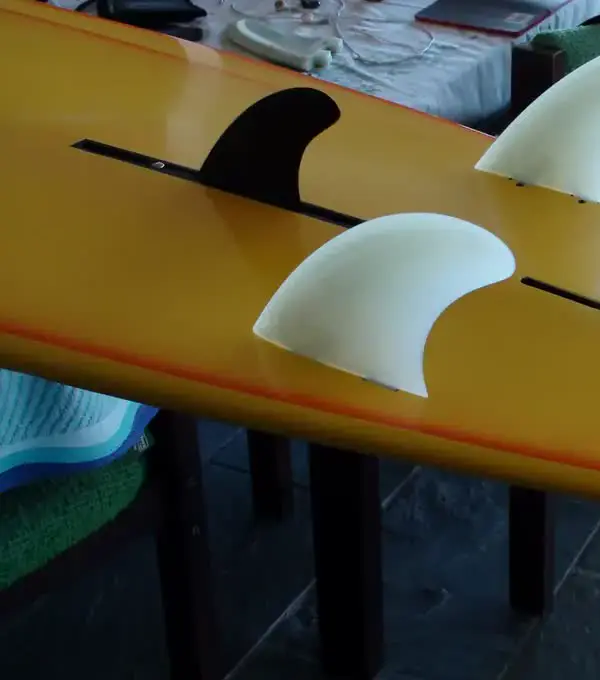
Water density alters fin foil dynamics. Stiff fiberglass or carbon-composite fins track with exceptional precision in dense, cold water. Avoid soft, overly flexible composite plastic fins in winter swells—dense water will over-flex them through bottom turns, resulting in sluggish, delayed projection out of turns. Read our Fin Systems Guide to compare quad vs. thruster dynamics for cold-water speed generation.
Cold Water Fin Rule: Choose Stiff Glass/Carbon Construction + Slightly Smaller Foil Area to Offset Water Density Resistance
3. Preventing Cold-Shock Delamination
Never bring an ice-cold surfboard directly from your sub-freezing vehicle roof rack into a boiling hot shower or place it immediately beside a heat source. Rapid thermal expansion causes air inside closed-cell foam to expand violently, leading to skin delamination. Let your board warm up gradually at room temperature.
Pro Tip: Booties dampen your natural foot sensations on the deck. Place a thin strip of raised traction wax right in front of your tail pad to give your rear bootie a tactile landmark when setting up for critical turns.
Frequently Asked Questions About Cold Water Surfboards
How much volume should I add to my surfboard for cold water?
Most surfers should add 5% to 15% more volume (typically between 1.5 and 4.0 liters) to their standard shortboard volume. Surfers wearing thick 5/4mm or 6/5mm wetsuits with boots and gloves need the higher end of that spectrum to compensate for body weight and reduced paddling endurance.
Is an epoxy surfboard good for cold water surfing?
Epoxy (EPS) works well in clean, windless cold-water conditions thanks to its superior buoyancy. However, in freezing, windy, or choppy winter surf, lightweight epoxy boards can feel overly stiff and chatter over surface chop. Many cold-water surfers prefer traditional PU boards or reinforced carbon constructions that provide dampening through heavy water.
What shape should a beginner choose for cold water surfing?
A beginner should opt for a high-volume soft-top or a wide, epoxy mid-length between 7'6" and 8'6". The board should feature a wide nose, flat entry rocker, and a forgiving squash tail. This setup offsets the stiffness of winter wetsuits and allows beginners to paddle into crumbly winter swells with stability.
Does cold seawater make your surfboard float differently?
Yes. Cold saltwater is denser than warm water, which technically produces slightly more buoyant lift once moving. However, this hydrodynamic advantage is far outweighed by the added physical weight of your wet neoprene gear (up to 12 lbs) and water friction, meaning you still need a higher-volume board to catch waves easily.
Should I ride a thruster or quad fin setup in winter surf?
Quads are exceptionally effective for cold water beach breaks and punchy wind swells because they generate effortless speed through flat sections. For organized, powerful winter groundswells and heavy ledging points, a classic thruster setup offers the predictability, pivot, and control needed to manage steep drops.
Summary: Choosing Your Ideal Winter Craft
Winter brings uncrowded lineups, legendary swells, and pristine offshore winds—if you have the right equipment to meet the challenge. By upgrading to a dedicated cold water surfboard that accounts for neoprene weight, physical fatigue, and raw oceanic energy, you transform freezing sessions into peak surfing memories.
- Assess your volume needs using our Volume Calculator.
- Choose your materials carefully, favoring dampening PU or reinforced constructions for choppy winter winds.
- Adjust your outlines toward round pins for groundswells or wide hybrids for short-period winter chop.
- Maintain your gear with ultra-cold wax and Gradual thermal storage.
Need personalized recommendations tailored to your local winter break? Consult our the board finder to dial in your exact winter surfboard dimensions today.