FCS vs Futures Fins: Which System is Right for You?
The ultimate comparison between FCS II and Futures fin systems. We break down the pros, cons, and performance differences to help you choose.
Surfboard Life · January 18, 2026 · 8 min read
FCS vs Futures Fins: Which System is Right for You in 2026?
The FCS vs. Futures debate remains one of the most enduring gear discussions in surfing. Both systems dominate the global lineup, backing World Tour champions, daily drivers, and alternative craft alike. Over the past few years, the gap between the two has narrowed in terms of material tech, template availability, and eco-conscious manufacturing.
Yet fundamentally, the two systems approach fin-to-box mechanics, base flex, and convenience differently. Here is an updated, technical breakdown of FCS II and Futures to help you choose the right setup for your quiver in 2026.
Overview of Each System
FCS (Fin Control System)
- Origin: Founded in 1992 in Australia; revolutionized the industry by replacing glass-on fins with a two-tab removable system.
- Current Standard: FCS II (keyless, tool-free click-in system). While original dual-tab FCS I fins can still be used in FCS II boxes via grub screws and silicone tab spacers, FCS II is the default standard worldwide.
- Market Share: Roughly 50–55% globally. FCS remains the dominant standard in factory production boards, soft-tops, and international retail channels.
- Box Mechanics: Two independent slots house two distinct fin tabs. FCS II uses an internal, corrosion-resistant rotating barrel/spring mechanism that catches the notched front tab and locks down the rear tab under downward hand pressure. Grub screw threads are still present in FCS II boxes, allowing surfers to screw fins in as a failsafe for heavy conditions.
Futures
- Origin: Founded in 1996 in Huntington Beach, California, by the Longo brothers with aerospace tooling backgrounds.
- Current Standard: Single-tab, continuous full-depth base secured via an angled front hook and a single angled grub screw at the rear.
- Market Share: Roughly 45–50% globally, with a particularly commanding presence in North America, Hawaii, and among custom high-performance shortboard shapers.
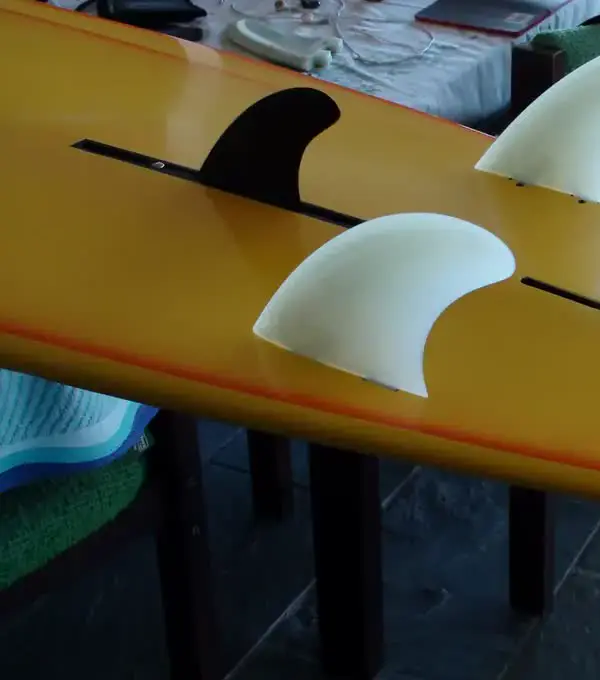
- Box Mechanics: A single, continuous rail routed into the foam blank, offering 1/2-inch depth (rear/center fins) or 3/4-inch depth (standard side fins for raked rails). The fin’s base sits completely sub-surface within the box, distributing lateral loads across the entire base length rather than across two isolated points.
Installation & Durability Comparison
| Feature | FCS II | Futures | | :--- | :--- | :--- | | Tool Requirement | Tool-free (snap-in); fin key optional | Fin key required (single grub screw) | | Swap Speed | 5–10 seconds per board | 30–60 seconds per board | | Mechanical Security | High (compression spring clip + optional screw) | Absolute (mechanical screw clamp) | | Base Contact Area | Split two-point contact | 100% continuous full-length rail | | Impact Failure Mode | Tabs often shear off inside the box | Box transfers load directly into foam core |
FCS II: Speed vs. Risk
- The Good: Unmatched convenience. You can swap from a twin-plus-trailer to a pure thruster in the shorebreak within seconds without digging through your vehicle for a key. Travel packing is faster, and there are no stripped screw threads to worry about.
- The Reality: While FCS has refined its spring-barrel durability in recent years, wipeouts over shallow sandbars or heavy reef encounters can occasionally dislodge a fin if it was not fully engaged. In 2026, many competitive and big-wave chargers ride FCS II fins but intentionally tighten standard grub screws into the boxes for peace of mind in heavy surf.
- Damage Profile: When you hit bottom, FCS tabs are engineered to shear before destroying the surrounding foam. While this means buying a replacement fin, it often saves you from an expensive fiberglass and foam reconstruction job.
Futures: Rigidity vs. Board Impact
- The Good: Bulletproof reliability. Once the 3/32" hex screw is tightened into the notched base, the fin cannot pop out unless the entire box fails. There is zero rotational wiggle or horizontal chatter at the base.
- The Reality: You must carry a fin key everywhere. Stripping a grub screw or rounding out a cheap hex wrench can ruin a dawn patrol.
- Damage Profile: Because the box and fin form a rigid structural beam, a high-velocity direct impact against rock or reef does not shear the fin cleanly. Instead, the torque can crack the glass flange or cave in the foam beneath the box, resulting in a more complex repair job than a snapped tab.
Performance, Drive, and Base Flex
Direct Drive: The Futures Advantage
Futures builds its reputation on immediate energy transfer. Because the entire base is housed inside a solid, pre-glassed polymer channel, the base of the fin cannot twist independently of the surfboard’s bottom contour.
- When you compress through an aggressive bottom turn, the energy goes directly into the rail without loss of leverage at the base.
- Surfers with a front-foot or power-oriented drive style who push hard through open-face carves often prefer this connected, rigid sensation.
Micro-Flex and Release: The FCS II Advantage
FCS II’s two-tab geometry leaves an open gap beneath the middle of the fin base between the plugs.
- Under maximum load, this architecture permits micro-torsion along the foil.
- Many shapers and light-footed surfers argue that this subtle base flex produces a springy, forgiving response off the top, facilitating rapid direction changes in punchy beach breaks.
- In choppy, turbulent faces, that microscopic dampening can make the board feel less chattery and more adaptive.
Does the Average Surfer Notice?
In blind flex tests, most intermediate surfers struggle to identify the box system underneath their feet. The overall template (area, sweep/rake, and base width), foil profile, and core material (carbon, honeycomb, fiberglass) impact the board’s feel far more significantly than the box design alone.
Your surfboard's tail width, bottom contours, and overall volume dictate how water releases off the tail long before box mechanics come into play.
Materials & Innovation (2025–2026 Updates)
Fin design has moved aggressively into advanced composite matrixes and sustainable materials:
Recent FCS Innovations
- Bio-Composite Resins: FCS has shifted widespread production of its Neo Glass and Performance Core lines to plant-based bio-resins and low-emission closed-loop molding, decreasing the carbon footprint without sacrificing flex memory.
- Refined Cam Profiles: Current FCS II boxes feature upgraded titanium-reinforced barrel springs with tighter tolerances, reducing mechanical wear and sand ingress issues seen in early iterations.
- Structured Categorization: FCS continues to anchor its line around four distinct turn dynamics: Reactor (tight pivot/speed), Performer (all-round balance), Accelerator (control/drive), and Carver (long, drawn-out turns).
Recent Futures Innovations
- Vapor Core & Apex Series: Futures’ latest carbon layups utilize hollow-core, pressurized air-compression molds and pre-preg carbon matrices, creating ultra-stiff base structures with precisely engineered tip whips.
- Alpha Recycled Fishing Nets: Produced entirely in Huntington Beach, the Alpha series blends post-consumer recycled fishing nets with localized carbon-infusion, delivering rigid performance at a sub-$100 price bracket.
- Universal Foil Refinements: New generation V2 and Vector foils combine flat-foil hold with curved-foil water attachment, making wider-tailed hybrid boards plane faster in weak conditions.
Cost and Ecosystem
- Price Parity: Premium fiberglass/carbon thruster sets from both brands sit firmly between $115 and $190 USD. Entry-level composite/nylon sets range from $45 to $75 USD.
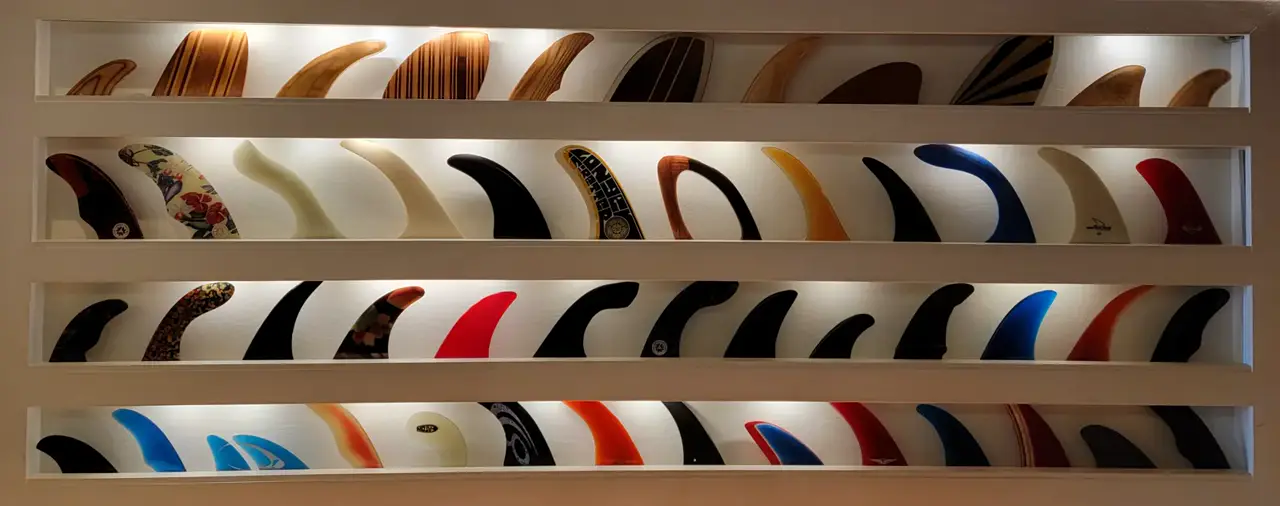
- Third-Party Availability: Independent fin manufacturers (such as True Ames, Captain Fin Co., Alkali, and Shapers) produce their popular templates in both FCS II and Futures bases. You will rarely miss out on a niche twin-fin, keel, or quad setup due to brand lock-in.
Decision Matrix: Which Should You Pick?
Choose FCS II if:
- You travel frequently by air: Stripping your fins to slide multiple boards into a travel coffin takes less than a minute, with no loose screws or fin keys to lose in your luggage.
- You adjust setups on the fly: If you like swapping between a quad and a thruster depending on how the tide changes during a two-hour session, the snap-in convenience is unmatched.
- You surf shallow beach breaks: Snapping a fin tab on a sandbar is far better than tearing a box completely out of the foam blank.
- Your local board market is FCS-heavy: In regions like Australia, Europe, and broad parts of Southeast Asia, finding a replacement FCS fin at a local shop is often quicker and easier.
Choose Futures if:
- You demand a rock-solid, zero-play connection: If you surf heavy reef breaks, ride big wave guns, or push maximum torque through your back foot, nothing beats a clamped single base.
- You hate worrying about fins popping out: You never want to wonder whether you heard that "click" correctly while paddling into a set.
- You appreciate structural longevity: Futures boxes integrate deep into the laminate structure, making the box itself less prone to internal mechanical failure over years of heavy cycling.
- Your shaper specializes in Futures: Many custom US and Hawaiian craftsmen balance their tail rockers and glass laminations specifically around the structural perimeter of Futures 1-piece boxes.
Can You Convert Boxes?
While converting a board from FCS II to Futures (or vice versa) is technically possible, it is not recommended:
- A professional shaper or glasser must mill out the original boxes with a router, reconstruct the structural core using high-density foam inserts, lay fresh glass patches, and route new boxes to precise cant and toe-in angles.
- The conversion costs between $150 and $250+ USD for a thruster or five-fin setup.
- This added weight around the tail can disrupt the board's balance and flex pattern. It is almost always better to sell your board and purchase one glassed with your preferred system.
Next Steps
To dial in your setup beyond just the base connection:
- Find the right template shape and fin balance on our comprehensive Fin Systems page.
- Match your fin dimensions directly to your tail shape and body dimensions using our Fin Finder tool.
- Explore how different board profiles leverage twin, thruster, and quad configurations across our guide to Surfboard Types.
Last updated: January 2026