Fall Surfboard Quiver Guide: Best Autumn Boards
Transition your setup for the autumn swell season. Our comprehensive fall surfboard quiver guide covers volume adjustments for rubber, regional wave profiles, design specs, and the best boards for every skill level.
Surfboard Life · October 26, 2026 · 13 min read
A fall surfboard quiver is a specialized selection of surfboards tailored to handle the transition from weak summer windswell to powerful, long-period autumn groundswells. An effective fall quiver typically pairs an everyday performance shortboard or hybrid with a dedicated step-up or pulled-in mid-length, incorporating 1–3 liters of additional volume to compensate for heavier cold-water wetsuits.
For surfers across the globe, autumn is the undisputed golden hour. As summer crowds thin and seasonal weather patterns flip, ocean basins awaken with deep low-pressure systems. From pumping North Pacific groundswells lighting up California pointbreaks to Atlantic hurricanes detonating along the Outer Banks and European beachbreaks turning into spitting barrels, the gentle rollers of July are officially history.
Surfing these heavier, faster, and colder waves on an under-gunned summer groveler is an exercise in frustration. To score the best waves of the year, you need a targeted strategy. In this comprehensive seasonal surfboard guide fall edition, we will break down the design parameters, regional considerations, cold-water volume physics, and board types required to build the ultimate fall surfboard quiver.
Summer to Autumn: Why Swell Dynamics Demand a Quiver Shift
Summer surf is defined by short-period wind swells, warm surface waters, and soft wave faces. Shapers design summer grovelers with flat entry rockers, wide outlines, and thick, buoyant rails to generate artificial speed across flat sections.
Autumn shatters this dynamic. According to seasonal forecasting data from Surfline, autumn marks the collision of lingering tropical systems and the birth of high-latitude winter low-pressure engines. These storms deliver groundswells with periods stretching from 14 to 20 seconds. Long-period swells travel deeper in the water column, refracting aggressively off reefs, points, and sandbars, causing wave faces to pitch significantly faster and hollow out with sheer kinetic force.
When you paddle a wide, flat summer board into a pitching 6-to-8-foot fall wave, two things happen: the flat nose rocker catches the steep trough, sending you over the falls, or the wide tail skitters uncontrollably down the face without holding an edge. Adjusting your board selection is not about vanity—it is about control, paddle acceleration, and survival.
Pro Tip: Transitioning from summer to fall is rarely an overnight leap to an 8-foot gun. Start your seasonal transition by stashing away ultra-wide fish shapes in favor of rounded pins or pulled-in thumbtails that engage the wave face as wave heights push past head-high.
Board Anatomy for Steep Autumn Waves: Rocker, Rails, and Fins
To choose the best surfboards for fall waves, you must understand how wave mechanics interact with surfboard architecture. If you need a refresher on terminology, explore our complete Surfboard Anatomy breakdown.
1. Continuous vs. Staged Rocker
Summer grovelers rely on staged (flatter) rocker profiles to skate across dead sections. Fall waves, however, possess deep curves. To match the arc of a steep autumn wave face, your board needs more continuous nose and tail rocker.
- Nose Rocker: A modern continuous entry rocker prevents pearling (nose-diving) during late, under-the-lip drops.
- Tail Rocker: Tail kick allows you to initiate vertical snaps in tight pockets and release the tail smoothly without snagging rail.
2. Rail Foil and Outline
Soft, boxy rails provide stability and float in mushy surf, but they bounce and chatter off the textured, high-speed faces typical of fall swells. Autumn designs favor medium-to-low, tapered rails. These bite into the water column, acting like an edge on a snowboard to provide instantaneous rail engagement inside hollow sections. Furthermore, outlines pull in dramatically toward the tail, shifting from wide squash and diamond tails to rounded pins and round tails.
3. Fin Configurations for Hold and Drive
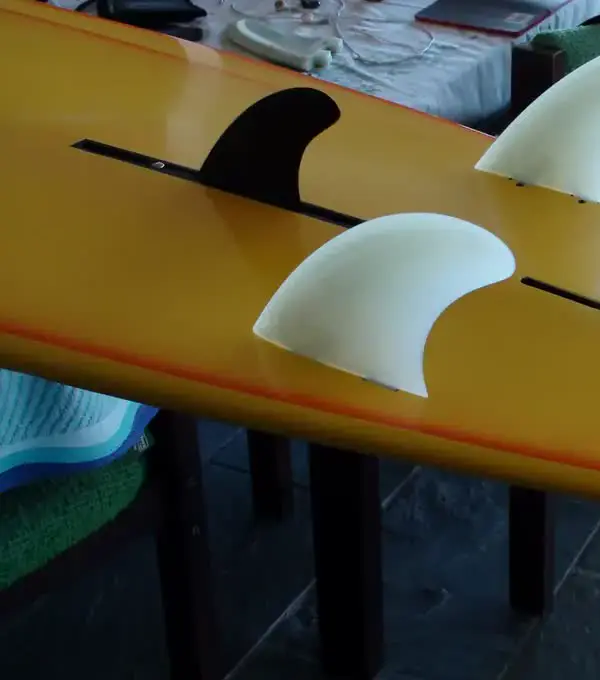
Fins govern hold, cavitation resistance, and forward drive. In our Fin Systems Guide, we detail how base width and rake alter board performance. In autumn conditions:
- Thrusters: The three-fin thruster remains the gold standard for controlled, pivot-heavy surfing in steep, overhead waves.
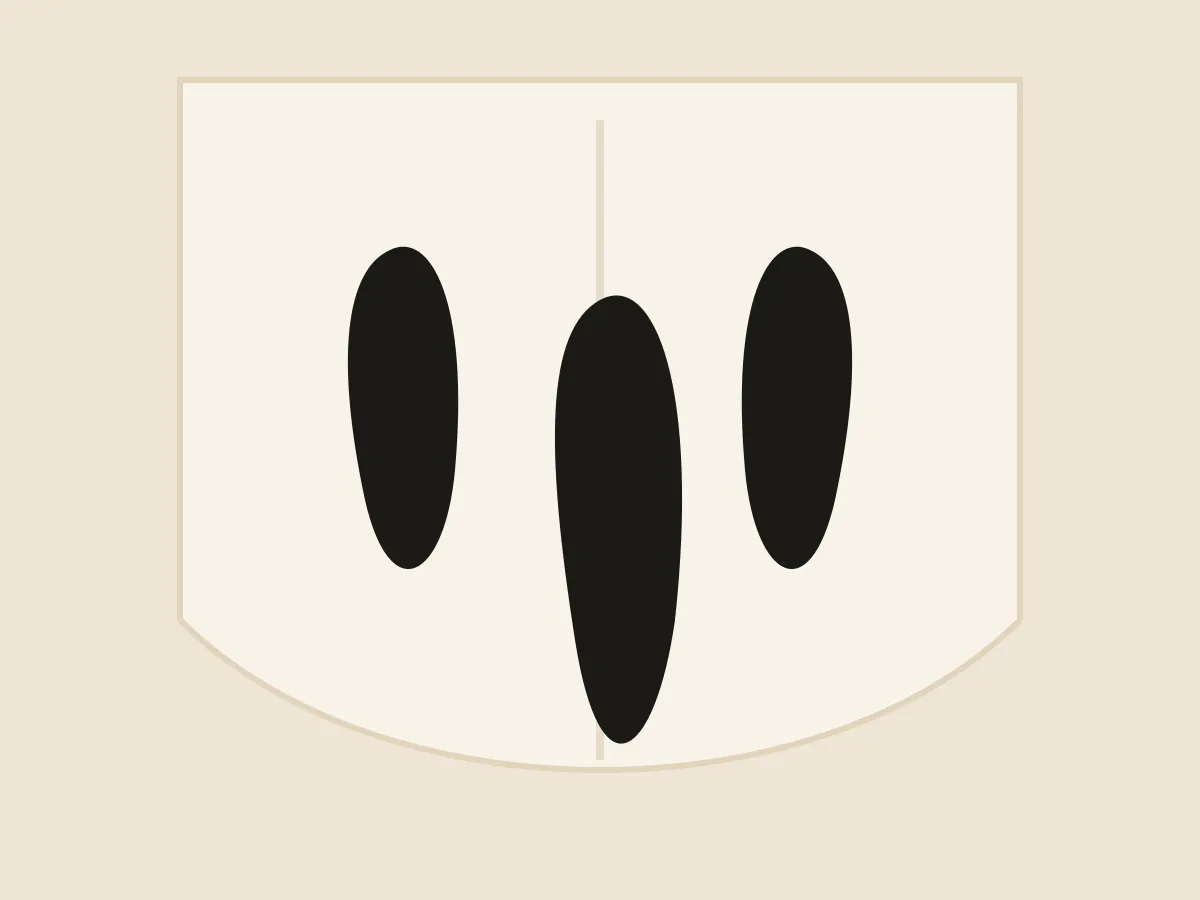
- Quads: A quad setup shines in fast, down-the-line autumn reef and point breaks. By removing the center fin drag, quads provide pure speed and anchor your rail higher on steep cylinder walls.
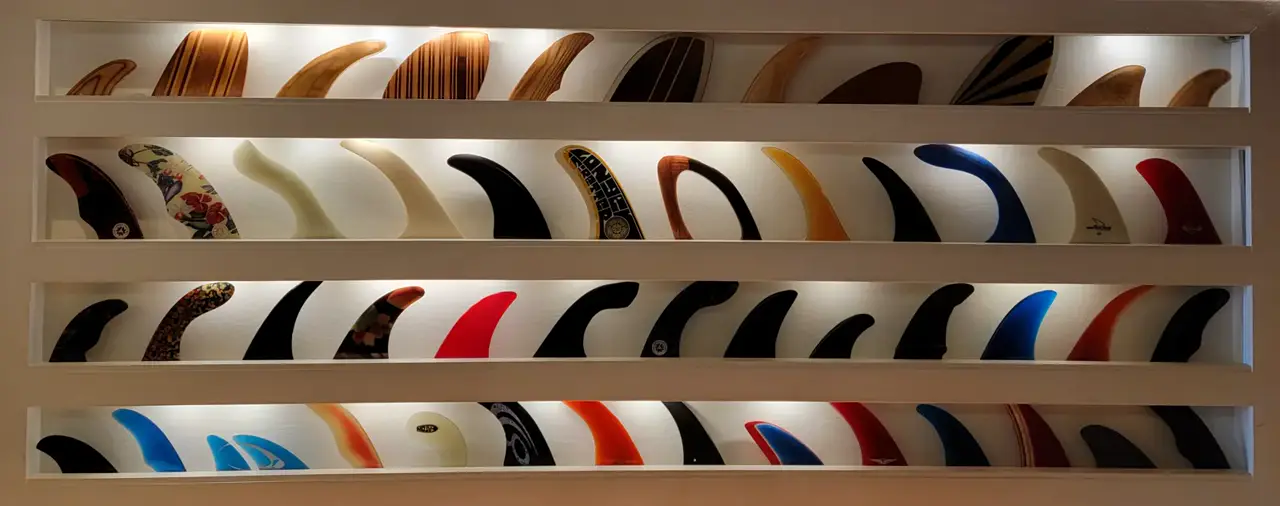
- Fin Construction: Swap out flexible composite fins for stiff fiberglass or solid carbon-matrix fins. Heavy water puts immense lateral pressure on your cluster; stiff fins eliminate unpredictable flex and give you absolute projection off the bottom turn.
The Cold-Water Volume Equation: Factoring in Rubber and Density
A critical oversight in any cold water surfing board choice is ignoring water temperature and neoprene weight. As water cools from summer highs of 70°F (21°C) down into the 50s and 40s (10°C–4°C), two distinct physical changes occur:
- Wetsuit Weight and Drag: Shifting from boardshorts to a 3/2mm, 4/3mm, or hooded 5/4mm wetsuit with booties adds between 5 to 10 pounds (2.2 to 4.5 kg) of dead, water-soaked weight to your body. Neoprene also restricts shoulder mobility, sapping paddling efficiency by roughly 10–15%.
- Water Density: Cold salt water is denser than warm salt water. While denser water theoretically increases a board's hydrodynamic lift slightly, this benefit is completely neutralized by the biomechanical drag and extra payload of thick rubber.
To maintain paddle speed and early entry into larger, fast-moving waves, you must scale your volume upward. Use our interactive Volume Calculator to dial in your baseline, and then apply this autumn adjustment rule:
$\text{Fall Target Volume} = \text{Summer Liters} + (1.5\text{L to } 3.0\text{L})$
If your peak summer shortboard is 28.0 liters, your baseline best surfboards for fall waves should measure between 29.5 and 31.0 liters. This incremental foam provides the early glide needed to chip into fast-moving swells without bogging your turns.
Pro Tip: Never add fall volume purely by increasing board width. Extra width catches cross-chop and resists banking into rail-to-rail turns. Instead, look for volume hidden along the board's stringer (thickness foil) and distributed forward under your chest.
How to Build the Ultimate Fall Surfboard Quiver
Whether you are constructing a minimalist one-board solution or a versatile three-board travel battery, structuring your fall surfboard quiver requires calculated spacing. For personalized recommendations based on your local break, visit our Board Finder Quiz.
                  FALL SWELL ARRIVES
                          │
        Is it under or over head-high?
         ┌────────────────┴────────────────┐
    UNDER HEAD-HIGH                  OVER HEAD-HIGH
         │                                 │
    Clean or Choppy?                 Point/Reef or Heavy Beach?
   ┌─────┴─────┐                     ┌─────┴─────┐
 CLEAN       CHOPPY               POINT/REEF    HEAVY BEACH
   │           │                     │             │
Performance  Performance          Modern        Step-Up
Fish / Mid   Shortboard (PU)      Quad Mid      Round Pin
The One-Board Fall Quiver: The High-Performance Hybrid
If budget or storage limits you to a single stick, choose an All-Around Performance Hybrid:
- Dimensions: 1–2 inches shorter than your height, slightly pulled-in round tail.
- Volume: Summer baseline + 1.5 liters.
- Rocker: Moderate continuous entry with medium tail exit.
- Why it works: It catches shoulder-high transition days with ease but holds its line reliably when a solid overhead groundswell hits your local spot.
The Three-Board Autumn Arsenal
For surfers looking to milk every drop of autumn potential, a three-board system covers all swell scenarios:
- The Daily Performance Driver (Head-High Workhorse): Standard shortboard outline, round squash tail, thruster setup. Designed for clean, chest-to-overhead autumn conditions.
- The Step-Up / Mini-Gun (Overhead to Double Overhead): 2–5 inches longer than your standard shortboard, pulled-in round pin tail, increased forward thickness foil. Essential for early paddle entry, holding clean lines, and negotiating heavy currents.
- The High-Performance Mid-Length or Performance Fish (Lulls & Soft Waves): Ranging from 6'6" to 7'2" (or a refined quad fish). Bridges the gap between groundswell pulses, keeping paddle fitness high when conditions drop to waist-high without reverting to a sluggish summer log.
Dive deeper into each category within our comprehensive Board Types Guide.
Regional Fall Surfing Breakdown: West Coast, East Coast, and Europe
Autumn does not treat every coastline equally. Your autumn surfboard guide must account for bathymetry, swell angles, and local weather patterns. Regional insights from professional coverage on Surfer Magazine highlight how regional geography dictates hardware choices:
1. US West Coast (California & Pacific Northwest)
- Swell Profile: Autumn yields iconic "combo swells"—lingering South/SW swells colliding with inaugural NW winter pulses, accompanied by light offshore Santa Ana or morning winds.
- Target Board: Continuous-rocker performance thrusters for lined-up point breaks like Rincon, and a dedicated 6'4" to 6'8" step-up for heavy beach breaks like Ocean Beach, San Francisco.
- Neoprene Shift: Transition from springsuits/trunks in SoCal to 3/2mm and 4/3mm; NorCal/PNW surfers lock into heavy 4/3mm and 5/4mm rubber.
2. US East Coast (Florida to New England)
- Swell Profile: Peak hurricane season (August through October) transitions into brisk nor'easters. Waves are predominantly powerful, shifting beach breaks with short paddle-out windows.
- Target Board: Fast, highly responsive shortboards with plenty of lift under the chest to navigate dredging, low-tide shorebreak barrels. A quad-fin rounded diamond or swallow tail is deadly on rapid East Coast hurricane peelers.
- Neoprene Shift: Water cools abruptly in the Northeast, requiring boots and 4/3mm suits by late October, while Florida surfers enjoy warm water well into November.
3. Atlantic Europe (France, Portugal, UK, Ireland)
- Swell Profile: North Atlantic low pressures spin violently, lighting up the sandbars of Hossegor, Portugal's heavy slabs (Supertubos, Ericeira), and Irish reef passes. World-class performances documented by World Surf League events showcase the raw power of this zone.
- Target Board: Heavy-duty glassed step-ups and round pins capable of handling massive water movement and punchy, shifting peaks. A sturdy 6'6" to 7'0" pin-tail step-up is mandatory when Atlantic beach breaks roar.
- Neoprene Shift: Portugal remains manageable in a 3/2mm, but Ireland and the UK rapidly demand 4/3mm and 5/4mm armor with integrated hoods.
Fall Surfboard Quiver Selection Matrix
| Surfer Profile | Primary Fall Board | Dimensions vs. Summer | Tail Shape | Fin Setup | Primary Use Case | | :--- | :--- | :--- | :--- | :--- | :--- | | Progressing Beginner | Performance Mid-Length | +2" to +4" longer, same volume | Rounded Thumb | 2+1 or Single | Transitioning from soft-top to steeper green waves | | Intermediate | High-Volume Hybrid Shortboard | Same height, +1.5L to +2L | Round Tail | Thruster | All-around head-high autumn beach & point breaks | | Advanced / Charger | Step-Up / Mini-Gun | +3" to +6" longer, +2L to +3L | Round Pin | Quad or Thruster | Double-overhead groundswells, dredging barrels | | Cruiser / Style-Oriented | Performance Quad Fish | +1" longer, -1/2" width | Swallow | Stiff Keel / Quad | High-speed down-the-line points and clean reef peelers |
Fall Surfboard Quiver by Surfer Skill Level
Optimizing your setup depends heavily on your current experience level. If you are still working on fundamentals, explore our guide on how to Learn to Surf before stepping into heavy fall conditions.
The Post-Summer Beginner
If you learned to surf during summer on a 8'0" soft-top, do not make the classic mistake of immediately buying a 5'11" pro-model shortboard when autumn arrives. Steeper, faster waves will simply lead to wipeouts and lost confidence.
Instead, graduate to an egg or fun-shape between 7'2" and 7'6" with tapered rails and a 2+1 fin configuration. This provides the safety margin and paddle speed of a longboard while giving you the rail control necessary to ride across steeper autumn wave faces without skidding out.
The Progressing Intermediate
Intermediates can generate speed on summer grovelers but struggle with control when the surf pushes past head-high. For your fall setup, invest in a round tail hybrid. A round tail maintains surface area directly under your back foot for drive while eliminating the hard corners of a squash tail, delivering smooth, locked-in arcs during high-speed bottom turns.
The Advanced Surfer / Weekend Warrior
Advanced surfers need reliable transition tools. A standard performance shortboard handles 80% of autumn days, but having a genuine step-up stashed in your vehicle makes the difference between watching from the cliff or paddling out during the swell of the season. Aim for a board 3 to 5 inches longer than your everyday board, with lower entry rails and a narrow, pulled-in pin tail designed to hold line through critical drops.
Pro Tip: If you frequently surf heavy fall sandbars or shifting reef slabs, ask your shaper for a 5-fin convertible box setup. This allows you to run a responsive thruster in peaky beach breaks and switch to a locked-in quad for barreling, ledgey points.
Durability and Construction: Polyurethane vs. Epoxy in Autumn Elements
Autumn surfing brings rougher conditions: heavier shorebreak, floating debris from seasonal storms, and strong offshore winds that turn light boards into airborne kites. Selecting the right board construction is essential for both performance and board lifespan.
Polyurethane (PU) vs. Expanded Polystyrene (EPS)
- Traditional PU/Polyester: PU boards remain the undisputed king for autumn groundswells. Polyurethane is denser and absorbs ocean chatter, keeping the board planted in choppy or wind-blown conditions. When you are dropping into an 8-foot wave face with strong offshore updrafts, the extra weight of a PU blank ensures the board cuts cleanly through the chop rather than bouncing off the surface.
- EPS/Epoxy: While lightweight and lively in small summer surf, ultralight EPS boards can feel skittish, buoyant, and overly stiff in heavy fall swells. However, high-density epoxy builds featuring composite stringers or carbon vector nets offer superior tensile strength against snapped boards in heavy beach breaks.
Glassing Schedules and Maintenance
A standard summer glassing schedule of 4oz deck + 4oz bottom is dangerously fragile for powerful autumn surf. As outlined by industry board builders on Stab Magazine, stepping up your glassing schedule to a heavy team or standard fall glassing—4oz + 6oz deck with a 4oz or 6oz bottom—increases dent resistance and torsional strength.
Before launching into the first major swell of the season, inspect your equipment for hairline fractures and stress cracks. Address dings immediately by checking out our Repair Center to avoid waterlogging your core in heavy surf.
┌────────────────────────────┐      ┌────────────────────────────┐
│     TRADITIONAL PU         │      │        EPS / EPOXY         │
├────────────────────────────┤      ├────────────────────────────┤
│ • Dampens wind chop        │      │ • High strength-to-weight  │
│ • Smooth rail penetration  │      │ • Very fast in clean surf  │
│ • Preferred for step-ups   │      │ • Can bounce in offshore   │
│ • Heavier baseline weight  │      │ • Stiffer flex profile     │
└────────────────────────────┘      └────────────────────────────┘
The Evolution of Autumn Quivers in Surfing History
Surfers have spent decades adapting their gear to changing seasons. In our comprehensive look at Surfing History, early Hawaiian pioneers understood that the winter and autumn swells of the North Shore demanded longer olo and alaia craft compared to summer rides on the south side of Oahu.
During the shortboard revolution of the late 1960s and 70s, legendary shapers like Dick Brewer recognized that flat-bottom, wide-tailed transition boards spun out in powerful surf. Brewer refined the mini-gun, pairing pulled-in pintails with teardrop templates—principles that still dictate how modern shapers build our favorite autumn step-ups today.
Still unsure which dimensions match your height, weight, and local wave profile? Consult with our intuitive the board finder for personalized board and fin pairing recommendations.
Summary: Ready Your Equipment Before the First Swell Hits
Building an effective fall surfboard quiver is all about thoughtful preparation. Autumn delivers the cleanest, most powerful waves of the entire year, but it quickly exposes flaws in board choice, fin setups, and paddle fitness.
By adding 1.5 to 3 liters of volume to offset your heavier wetsuit, choosing continuous rockers with tapered rails, and selecting stiff, dependable fins, you equip yourself to take full advantage of every major swell. Don't wait until the horizon turns black with lines of incoming groundswell—dial in your autumn quiver today, wax up your rails, and make this fall season your best one yet.
Frequently Asked Questions
How much volume should I add to my fall surfboard quiver for cold water?
As a general rule, add 1.5 to 3.0 liters of volume to your fall surfboard compared to your summer shortboard. This compensates for the extra 5 to 10 pounds of wet neoprene (boots, gloves, and 4/3mm or 5/4mm wetsuits) and combats the reduced shoulder mobility that limits your paddling power in colder water.
Can I use my summer fish as an everyday fall surfboard?
While a classic wide twin-fin fish works on softer, knee-to-chest-high autumn transition days, it quickly loses drive and control in steep, overhead surf. For hollow, powerful fall waves, opt for a performance quad fish or a rounded pin-tail hybrid with more rocker and drawn-in rails to prevent pearling and sliding out.
What is the ideal fin configuration for powerful autumn waves?
A thruster (tri-fin) setup is ideal for powerful, vertical surfing in steep pockets, offering predictable release and control. Alternatively, a quad setup is exceptional for heavy down-the-line barrels and fast point breaks, delivering extra acceleration and edge hold on steep wave faces. Choose stiff fiberglass fins over flexible plastic composites.
Why do experienced surfers prefer PU over epoxy for heavy fall surf?
Polyurethane (PU) boards are naturally heavier and flex more smoothly through high-speed turns, absorbing chop and surface chatter caused by strong autumn offshore winds. Lightweight EPS/epoxy boards can feel corky, chattery, and difficult to set on rail when dropping down steep, textured wave faces.