Heavy Surfer? Find Your Ultimate Board Today!
Discover the best surfboards meticulously designed for the heavy surfer, especially those over 200 lbs. We dive into how to select the perfect big guy surfboard with high volume, ensuring stability, paddle power, and performance. Stop struggling and start shredding with the right equipment.
Surfboard Life · February 1, 2026 · 9 min read
To find the best surfboard for a heavy surfer (over 200 lbs / 90 kg), prioritize boards with significantly more volume and optimized dimensions to deliver ample buoyancy, stability, and paddle power. This typically means selecting boards that are longer, wider, and thicker, built with specialized contours and rail profiles designed to carry weight efficiently through the water without sacrificing maneuverability.
Surfing is about harnessing wave energy. For larger riders, the physics of water displacement dictate that body weight is the single most critical factor in board selection. If you weigh over 200 lbs, you have likely dealt with the frustration of sinking, bogging rails, struggling to match wave speeds while paddling, or feeling unsteady on boards made for sub-170 lb frames.
The industry has transformed in recent years. Modern CAD modeling, high-strength composite materials, and a shift toward high-performance volume distribution have expanded the big guy surfboard market. Larger surfers no longer have to settle for clumsy, oversized planks; modern designs pair generous float with responsive handling. This comprehensive guide details the shapes, technologies, and volume targets that will transform your surfing experience.
Understanding Volume: The Heavy Surfer's True Metric
For a heavy surfer, understanding volume is essential. Expressed in liters (L), volume measures the total three-dimensional displacement of a surfboard and directly dictates its buoyancy. A board with adequate volume floats you higher, reduces hydrodynamic drag, accelerates your paddle speed, and allows you to catch waves earlier.
Standard off-the-rack boards are typically engineered around a median rider weight of 150 to 175 lbs. Under a 200+ lb surfer, an undersized board sinks past its natural waterline. This increases surface drag, makes paddling exhausting, and causes the tail to bog when you attempt to drive down the line.
Pro Tip: Never judge a board by length alone. A flat, wide 6'4" hybrid can easily carry 46 liters of volume, while a knife-railed 6'10" step-up gun might pack only 38 liters. Always evaluate liters alongside the board's width, thickness, and rail profile.
To dial in your target volume based on your weight, skill level, and fitness, use our Volume Calculator. As a rule of thumb, experienced surfers over 200 lbs generally need at least 38–48 liters on a shortboard, while intermediate and progressing surfers thrive in the 48–70+ liter range, scaling up past 80–90+ liters for mid-lengths and longboards.
Modern shapers emphasize that adequate volume is not a shortcut or a handicap—it is a functional requirement to level the playing field. When your board sits at the proper waterline, you plane quickly, paddle efficiently, and set clean rail lines through turns.
Why Volume Equals Performance for Heavier Surfers
- Explosive Paddle Speed: Floating on top of the water instead of plowing through it lets you match wave velocity earlier and conserve energy for your ride.
- Stable Pop-Ups: Additional surface area and volume create a firm platform that won't wobble or submerge under rapid, heavy foot transfers.
- Momentum Retention: Extra liters carry your frame across soft, flat, or mushy wave sections where smaller boards sink and lose drive.
- Clean Rail Engagement: Properly placed volume allows the rail to slice through the water face cleanly without bogging the board's tail.
Best Board Types for the Heavy Surfer
Selecting the right category depends on your experience, local wave types, and personal approach. For an overview of every design archetype, check out our Board Types Guide.
1. The Big Guy Performance Shortboard
Carrying weight does not mean you have to surrender high-performance surfing. Modern performance shortboards designed for heavier surfers feature tuned outlines, strategic foam distribution, and refined foils. Rather than merely blowing up standard dimensions, shapers use CAD platforms to pack foam under the chest and along the stringer while tapering the rails, nose, and tail.
- Design Features: Broad center widths (20.5" to 22"), thicknesses of 2.75" to 3.25", and volumes running from 38 to 52+ liters. Modern variations often pair single-to-double concave bottoms with tail channels for lift and drive, alongside slightly elevated tail kick to keep the board responsive through vertical turns.
- Tech & Materials: Look for lightweight EPS/epoxy cores reinforced with carbon vector nets or deck-patch reinforcement. These provide flex response and resist the deep heel compression dents that larger power surfers often create.
- Best For: Advanced heavy surfers surfing punchy beach breaks, points, or reef breaks who want to carve, hit the lip, and generate steep down-the-line speed.
- Watch Out For: Demands solid fitness and clean technique; will feel sluggish and bog down in slow, gutless surf.
2. Modern Hybrids & Funboards
Hybrids blend the paddle mechanics and wave-entry stability of a mid-length with the turning freedom of a shortboard. For the everyday surfer over 200 lbs, this is usually the most dependable one-board quiver.
- Design Features: Ranging between 6'6" and 7'8", hybrids feature relaxed entry rockers, fuller forward profiles, and wider swallow, round, or diamond tails. Typical volumes range from 46 to 62 liters. Advanced five-fin convertibles (allowing thruster or quad configurations) give riders adaptability across conditions.
- Tech & Materials: Refined, beveled (chined) rails pack float along the center deck while allowing the board's edges to bite into the wave face smoothly without catching.
- Best For: Intermediate to advanced heavy surfers seeking an everyday board for everything from knee-high rollers to overhead surf.
- Watch Out For: Hybrid outlines are wider through the nose and center, making tight vertical turns in steep pockets more challenging than on dedicated shortboards.
3. The Modern Fish
Fish surfboards are exceptional tools for heavier surfers surfing small to medium waves. Their flat rocker, broad forward foil, and distinct swallowtails create lift and down-the-line speed with minimal wave energy.
- Design Features: Typically ridden between 5'10" and 6'10" for larger surfers, carrying 40 to 55+ liters. Modern fish designs feature subtle single-to-double concaves or vented spiral V-bottoms, balancing loose glide with bite.
- Tech & Materials: Paired with modern keel or split-keel twin configurations, or set up as a high-drive quad. High-density stringers and bio-epoxy laminations prevent excessive twisting under heavy torque.
- Best For: Mushy, weak, or sloping waves where maintaining momentum is tough. Perfect for drawn-out carves and high-line trimming.
- Watch Out For: Can feel skittish, overpowered, and tough to slow down in steep, hollow, or heavy surf.
4. Performance Mid-Lengths & Mini-Malibus
Mid-lengths continue to dominate modern lineups, and for good reason: they offer unmatched paddle glide and wave counts without the sheer bulk of a full 9-foot log.
- Design Features: Ranging from 7'0" to 8'6", mid-lengths offer volumes from 52 to 78+ liters. Modern profiles feature low-drag entries, subtle vee-to-concave bottoms, and pulled-in round pin or thumb tails that allow heavy riders to execute smooth, rail-to-rail turns.
- Tech & Materials: Bio-resin and lightweight composite layups make modern mid-lengths significantly lighter than traditional polyurethane funboards, reducing swing weight and making transport easier.
- Best For: Beginners transitioning from foam boards, intermediate surfers wanting high wave counts, and heavy surfers seeking a flowing, stylish ride.
- Watch Out For: Difficult to duck dive once volume passes 55–60 liters; requires mastering turtle rolls in heavier break lines.
5. Modern Longboards (9'0"+)
For sheer wave-catching dominance, smooth trim, and classic style, a performance or traditional longboard is unmatched. The extended waterline creates effortless glide, making it an essential platform for surfers of any weight.
- Design Features: Lengths of 9'0" to 10'0"+, widths of 23" to 24", and volumes ranging from 72 to well over 100 liters. Modern longboards feature versatile 2+1 fin configurations, concave nose pockets for lift during noserides, and flattened rockers through the midsection for sustained trim speed.
- Tech & Materials: Carbon-laced rails, flax-fiber reinforcements, and EPS constructions keep overall weight down while preserving structural strength under heavy foot pressure.
- Best For: Beginners, cruisers, dedicated noseriders, and micro-swell days.
- Watch Out For: Difficult to transport, impossible to duck dive, and challenging to manage safely in crowded, heavy break zones.
Recommended Volume Ranges (Surfers 200+ lbs / 90+ kg)
| Board Type | Skill Level | Target Volume (Liters) | Optimal Wave Size | | :--- | :--- | :--- | :--- | | Performance Shortboard | Advanced | 38 – 52+ L | 3 – 8 ft (Punchy / Hollow) | | Hybrid / Funboard | Intermediate – Advanced | 46 – 64+ L | 2 – 6 ft (Everyday conditions) | | Fish (Twin / Quad) | Intermediate – Advanced | 42 – 56+ L | 1 – 5 ft (Mushy / Average) | | Mid-Length / Mini-Mal | Beginner – Advanced | 54 – 80+ L | 1 – 6 ft (Soft / Rolling) | | Longboard (9'+) | Beginner – Advanced | 72 – 105+ L | 1 – 4+ ft (Small / Clean) |
Note: Your optimal volume depends on your fitness, age, wetsuit thickness (cold water adds weight and restricts movement), and personal style. If you are torn between two sizes, choose the higher-volume option.
To narrow down your best option, try our Board Finder Quiz.
Custom Shaping vs. Off-the-Rack
While standard production boards offer wider choices than ever, a custom board remains an incredible investment for surfers weighing 200 to 260+ lbs.
- The Custom Route: Working directly with a shaper allows you to customize the glassing schedule (e.g., adding a 6 oz + 4 oz deck patch or opting for basalt/S-cloth reinforcement) to prevent heel dents. A shaper balances volume distribution along the center stringer while keeping rail dimensions tailored to your hands and turning style.
- The Off-the-Rack Route: Stock models from reputable brands are ready to ride immediately, thoroughly tested, and generally cost less. Look for designated "Big Guy," "Step-Down," or "XL" board ranges from established board builders.
When ordering custom, be honest about your fitness, dry weight, wetsuit gear, and typical surf conditions. This transparency ensures the finished board floats you as planned.
Fins, Foils, and Board Anatomy for Power Surfers
Heavy surfers transfer substantial leverage through their feet into the deck and fins. Managing this power requires the right hardware and rail profiles. Read our comprehensive Fin Systems Guide for more setup details.
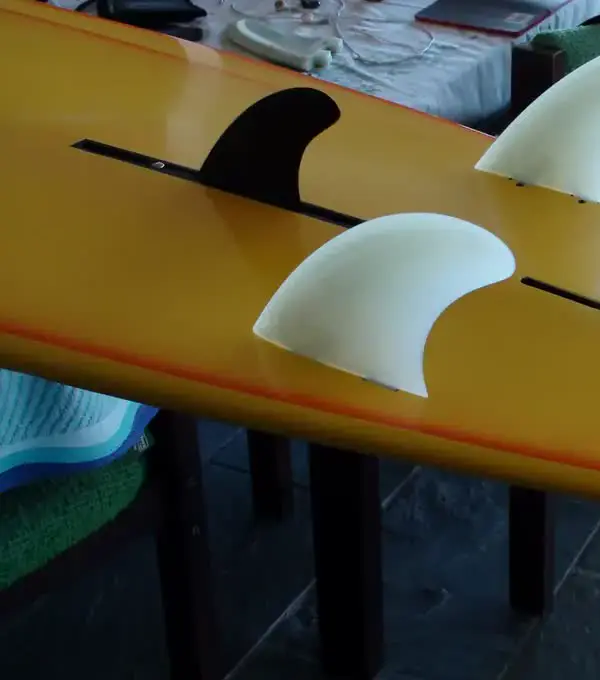
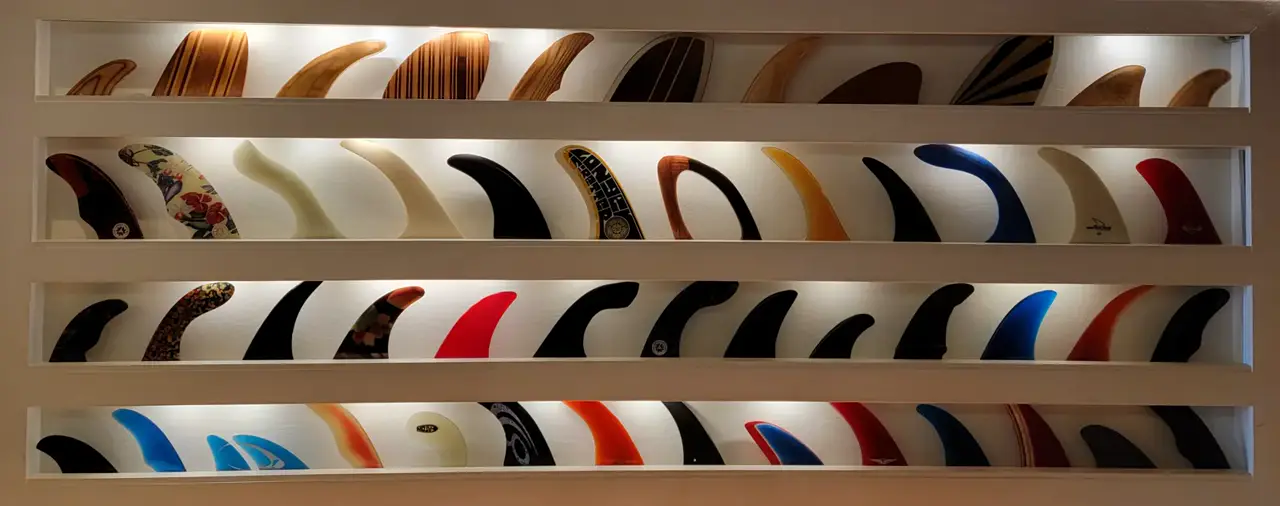
- Fin Size Matters: Surfers over 200 lbs should almost universally ride Large (L) or Extra-Large (XL) fin templates. Small or medium fins lack the surface area to hold your line through turns, leading to slide-outs and lost drive.
- Stiffness over Flex: Soft composite or budget plastic fins flex excessively under heavy loads. Opt for solid fiberglass, carbon base blends, or performance honeycomb constructions that store and release energy smoothly through turns.
- Rail Geometry: Learn more about how rail shapes work in our Surfboard Anatomy breakdown. For larger surfers, beveled or step rails pack high volume into the board's core while leaving a thinner rail line at the perimeter to slice into the wave face cleanly.
Board Care and Durability
Heavier surfers place high physical demands on boards during pop-ups, turns, and heavy drops:
- Invest in Stronger Glassing: Standard ultra-light shortboard glassing (single 4 oz deck and bottom) will dent quickly under heavier frames. Look for 6+4 oz deck glassing schedules or advanced carbon-wrap and epoxy composite builds.
- Inspect Fin Boxes and Plugs: Heavy torque on fin systems can crack resin around the boxes. Regularly check fin bases for stress fractures or movement.
- Repair Dings Immediately: Taking on water rapidly destroys buoyancy and ruins light foam cores. Keep UV solar-cure resin in your kit, or visit our Repair Center to learn proper repair methods.
Technique and Physical Preparation
Having the right high-volume board sets the foundation, but adapting your surfing technique to your frame unlocks your real performance potential.
- Paddle with Clean Form: Keep your chin down and chest slightly elevated, resting directly over the board's balance point. This prevents the nose from lifting or pushing water.
- Explosive Pop-Up Mechanics: Focus on hip mobility and quick, decisive foot placement. Avoid dropping your knees onto the deck; land your feet cleanly along the center stringer to keep the board stable.
- Drive with Your Back Foot: Modern high-volume designs turn best when steered directly from the tail pad. Keep your back foot settled right over the fin clusters to initiate